
 Why visible dust is often a symptom of a larger process problem—not just a housekeeping issue
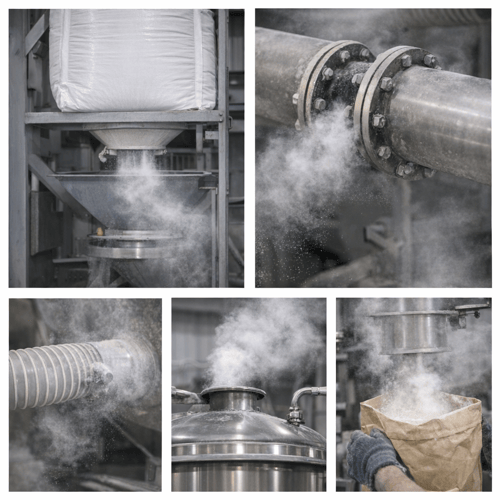
Walk through almost any facility that handles powders, granules, or dry bulk solids and you'll likely find dust somewhere. It may appear as a light coating on equipment, residue around transfer points, or powder collecting near filling stations.
Many facilities accept this as simply part of the process. But what if nuisance dust isn't the problem? What if it's actually a symptom that something else within the process deserves attention?
Whether you're producing specialty chemicals, pharmaceuticals, food ingredients, minerals, or plastics, dust can provide valuable clues about equipment performance, material flow, and containment effectiveness.
Dust Doesn't Usually Appear Without a Reason
Powders don't simply decide to leave the process. Visible dust is usually the result of something happening inside the system, such as:
- Material falling too far during charging
- Air being displaced faster than it can escape
- Small leaks around seals or flexible connections
- Particle degradation during conveying
- Material flow issues inside hoppers or vessels
Finding dust outside the equipment often means material is escaping somewhere it shouldn't. Instead of asking, "How do we clean this up?" it can be more productive to ask, "Why is this happening in the first place?"
Looking Beyond Housekeeping
While housekeeping is important, cleaning addresses the result—not the cause. Recurring dust accumulation may indicate opportunities to improve material containment, process efficiency, operator exposure, product recovery, and equipment reliability. Sometimes relatively small process changes can significantly reduce the amount of dust generated during normal operation.
Where Should You Start?
Before investing in new equipment, it's helpful to identify where dust is actually being generated. Some common areas include:
- Manual bag dumping
- Bulk bag unloading
- Reactor charging
- Pneumatic conveying
- Vessel filling
- Packaging operations
- Screening and blending
Each application creates dust for different reasons, meaning the solution is rarely "one size fits all."
Learn More
This article only scratches the surface. For a much deeper technical discussion—including why nuisance dust develops, common dust-generating operations, health considerations, and combustible dust hazards—our powder handling expert Jake Davis recently authored Part 1 of a two-part series for Processing Magazine: Why Fugitive Dust Is More Than a Housekeeping Problem. The article explores the underlying causes of nuisance dust and why addressing them early can improve both process performance and workplace safety.
Read the full Processing Magazine article →