
When people think about corrosion, they typically picture metals reacting with liquids or aggressive chemicals. But in powder and bulk solids processing, corrosion is also a critical—and often underestimated—factor. Certain powders, by their chemical nature or physical behavior, can actively degrade equipment, weaken system performance, and increase contamination or safety risks over time.
This first post in the series explores why corrosion happens with powders, how it affects material handling systems, and how De Dietrich equips customers to manage these challenges.
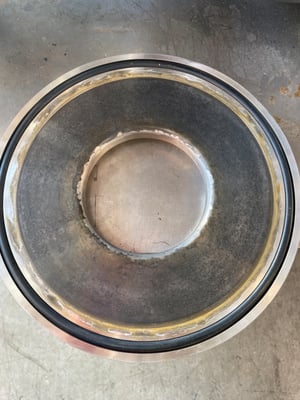
Filter Plate Discoloration
Why Some Powders Are Corrosive
Powders can become corrosive through a combination of chemical composition and physical behavior. In many cases, corrosion develops slowly and out of sight, making it easy to overlook until damage is already significant.
Some powders are inherently chemically reactive. Materials that contain halogens, strong acids, oxidizers, or reactive salts can attack metals and coatings even in what appear to be dry environments. While the reaction rate may be slow, the cumulative effect over time can be substantial.
A good example of this is the corrosion illustrated in the pictures above and below. A customer intended to use our Powder Pump system for a short trial (made from 316L materials of construction) and didn’t think it would be enough time for corrosion to take place. The product was an acid powder. Despite the short term use there was still noticeable evidence of corrosion starting to occur.
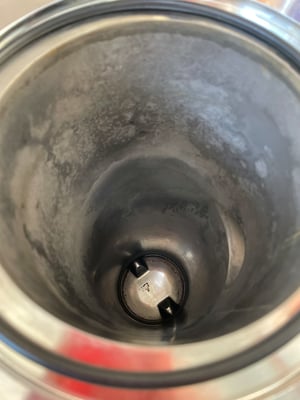
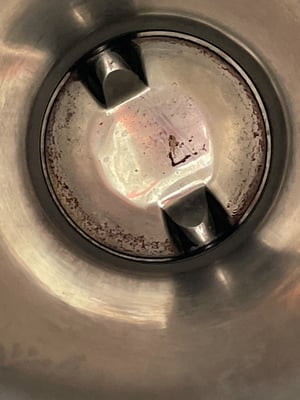
Left: Powder Pump body – Lighter discoloration and some cloudiness in inside walls of the receiver, especially in the impact zone for the product / Right: Outlet butterfly valve – Noticeable signs of rust starting around the edges of the disc.
Moisture also plays a major role. Hygroscopic or moisture-sensitive powders readily absorb humidity from the surrounding environment, creating microscopic liquid films on equipment surfaces. These localized wet spots dramatically accelerate corrosion, especially in areas where dust accumulates or flow is inconsistent.
In other cases, powders may carry residual solvents or release off-gassing vapors. These chemical byproducts can interact with metal surfaces, elastomers, hoses, and gaskets, leading to degradation even when the bulk material itself seems benign.
Finally, corrosion often works hand-in-hand with abrasion. Many powders are both chemically aggressive and mechanically abrasive, gradually wearing away protective coatings and exposing fresh metal underneath—creating a cycle that accelerates material loss.
How Corrosive Powders Affect Processing Systems
The impact of corrosive powders extends well beyond visible surface damage. Over time, corrosion can undermine both system performance and operational reliability.
1. Equipment Degradation
From an equipment standpoint, corrosion weakens containment integrity and compromises vessels, transfer lines, valves, and loading systems. In vacuum conveying systems and reactor vessels—such as those designed by De Dietrich—maintaining robust flow paths and selecting appropriate materials of construction is critical to long-term performance.
2. Product Contamination
Product quality is also at risk. Pitted or flaking metal surfaces can shed particles into the process stream, contaminating product batches and leading to deviations, rejected material, or costly rework.
3. Flow Interruptions
Corrosion further affects material flow. As internal surfaces become roughened, powders are more likely to build up, bridge, or arch, resulting in inconsistent feeding and unreliable transfer behavior.
4. Maintenance and Safety Risks
From a maintenance and safety perspective, corroded components tend to fail unpredictably. This increases the likelihood of unplanned downtime and, in some cases, creates hazardous conditions for operators and maintenance personnel.
Best Practices for Handling Corrosive Powders
While every material presents unique challenges, there are several widely accepted strategies for minimizing corrosion risk in powder handling environments:
1. Choose the Right Material of Construction (MOC)
Selecting the right material of construction is foundational. Corrosion-resistant options such as high-grade stainless steels, specialty alloys, or coated internals—including glass-lined steel—can significantly extend equipment life when matched correctly to the application.
2. Maintain Closed or Contained Systems
Where feasible, closed or contained systems should be considered. Containment reduces exposure to humidity and airborne contaminants while also improving operator safety. While budget or process constraints may limit these options, they should be evaluated early in the design phase.
3. Incorporate Moisture Control
Moisture control is another key factor. Dehumidification, nitrogen blanketing, and airtight transfer systems all help suppress corrosive reactions before they start.
4. Optimize Cleaning and Inspection Procedures
Routine cleaning and inspection play an equally important role. Regular visual checks help identify early signs of corrosion, and equipment designed for easy cleaning can prevent corrosive residues from accumulating in the first place.
5. Engineer Smooth, Coated, or Low-Adhesion Surfaces
Finally, engineering smooth, coated, or low-adhesion surfaces reduces powder buildup and limits the micro-environments where corrosion thrives. Solutions such as polymer linings (e.g., Tivar 88) or higher surface finishes can be effective, though careful consideration must be given to how these modifications may affect material flow behavior.
How De Dietrich Addresses Corrosion in Powder Handling
At De Dietrich, corrosion resistance is engineered into powder handling solutions from the outset—not treated as an afterthought.
Closed and contained transfer technologies, such as the Powder Pump vacuum conveying system, help prevent moisture ingress and reduce powder exposure to the surrounding environment—two major contributors to corrosion.
Equally important is system-level integration. De Dietrich routinely designs solutions that consider vessel materials, agitator compatibility, seals, gaskets, and ancillary components together. This holistic approach minimizes corrosion risk across the entire process line rather than addressing it in isolation.
De Dietrich also supports highly reactive, hygroscopic, and otherwise challenging powders through tailored solutions. These may include specialized materials of construction, nitrogen-assisted conveying, or even fully inert operating environments, depending on process requirements.
Closing Thoughts
Corrosion in powder systems doesn’t receive the same attention as mechanical wear or dust hazards—but it should. It directly affects product quality, worker safety, system reliability, and overall operating cost. Understanding how and why powders cause corrosion is the first step toward building more resilient and predictable processes.
As this blog series continues, we’ll explore additional powder characteristics—combustibility, cohesiveness, sensitivity to humidity, and more—and discuss how thoughtful engineering can transform challenging materials into predictable, controllable process streams.