 At De Dietrich, we’re often contacted about handling a variety of container types—from drums and super sacks to smaller 50 lb bags. In this article, we’ll focus specifically on how NFPA guidelines apply to the safe handling of 50 lb bags.
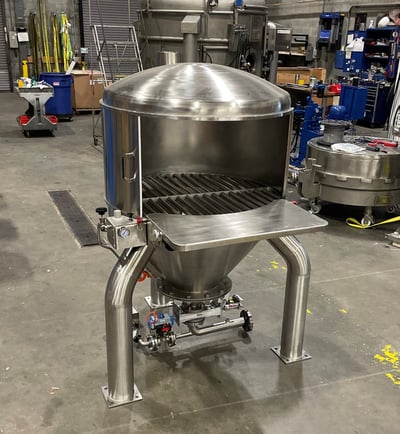
In most applications involving these smaller bags, the product is emptied into a hopper that feeds either a conveying system or directly into the process. When dealing with combustible dust materials, it’s essential to understand the risks involved—particularly when loading the bag dump station. NFPA guidelines provide a framework for identifying and mitigating these risks.
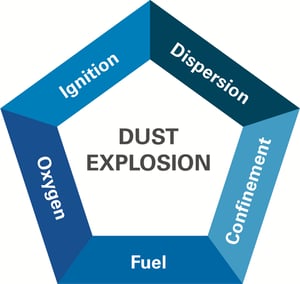
A Quick Refresher: The Dust Explosion Pentagon
A dust explosion requires five elements: fuel, air, ignition source, dispersion, and containment. All five must be present for an explosion to occur.
Key Considerations for Mitigating Dust Explosion Risk at Bag Dump Stations
1. Flash Fire Risk vs. Explosion Risk
Since bag loading is not a closed process, the “containment” component of the explosion pentagon is absent—meaning there is no actual explosion risk. However, that doesn’t mean there’s no hazard. In this scenario, the primary concern becomes flash fire risk.
NFPA guidelines require evaluating both explosion and flash fire hazards, including scenarios where flash fire risk exists without full explosion conditions.
2. Addressing Ignition Sources
One of the most straightforward ways to reduce risk is by eliminating potential ignition sources. This typically involves proper grounding and bonding of metallic equipment.
For materials with a Minimum Ignition Energy (MIE) below 30 mJ, it’s also essential for the operator to be grounded. Human discharge energy can reach up to 25 mJ—enough to ignite sensitive materials.
These precautions are consistent with NFPA guidance on controlling electrostatic discharge hazards. See NFPA 652 for more details.
3. Effective Dust Collection
Adequate dust collection is critical. Dust concentrations should be maintained at or below 25% of the Minimum Explosive Concentration (MEC). To ensure this is done properly, we strongly recommend working with a combustible dust expert to assess your system.
4. Operator Training & Administrative Controls
Proper training helps operators recognize and avoid introducing ignition sources and teaches best practices for handling materials to minimize dust cloud formation. Administrative controls are an essential layer of safety.
NFPA standards require facilities to conduct a Dust Hazard Analysis (DHA) and implement training, procedures, and hazard awareness to address identified risks.
5. Designing for Reduced Risk
When possible, designing the bag dump station with a holding volume under 8 ft³ (roughly the size of a 55-gallon drum) can help reduce risk. According to NFPA 652, indoor vessels with explosion risk and volumes below this threshold do not require explosion protection.
While typical bag dump stations may not pose a high explosion risk, a smaller volume design may further lower flash fire potential. Design decisions like these should be evaluated based on the specific material, process conditions, and applicable NFPA standards.
Final Thoughts on NFPA Guidelines and System Safety
These guidelines are specific to one piece of equipment—but real safety comes from evaluating the entire process and environment. NFPA standards are intended to be applied across the full system, not just individual pieces of equipment.
We recommend conducting a Dust Hazard Analysis (DHA) with a qualified combustible dust expert. While we design our systems with safety as a top priority, it’s ultimately the end user’s responsibility to ensure compliance with all applicable regulations and standards.
If you are unsure whether your current system meets NFPA guidelines, now is the time to evaluate it—before an incident or compliance issue arises.
At De Dietrich, we don’t perform DHAs ourselves, but we’ve supported many customers through the process. Our team can help you review your current setup, identify potential risks, and determine the right equipment approach for your application.
Contact us to discuss your bag handling system or NFPA-related considerations.