
Solid-liquid separation is one of the most critical steps in chemical and pharmaceutical manufacturing. From isolating active ingredients to removing impurities, the efficiency of this process directly impacts product quality, yield, and overall operational performance. Among the most effective technologies for this task are industrial centrifuges, which use centrifugal force to accelerate the separation of solids from liquids.
But not all centrifuges are created equal. The three most common types used in industrial applications are vertical peeler centrifuges, horizontal peeler centrifuges, and inverting filter centrifuges. Each design has unique advantages and is best suited for different process requirements.
This post focuses on batch-style centrifuges operating as an automated semi-continuous process. These high-speed batch centrifuges separate solids and liquids through a series of cycles. Each cycle consists of product slurry feed, filtration, spin dry of the solids material, washing of the solids, final spin dry, and discharge of the solids.
Vertical Peeler Centrifuges
How They Work:
Vertical peeler centrifuges are designed with a vertical basket or bowl that spins at high speed to separate solids from liquids. The slurry is introduced through the top of the centrifuge into the rotating basket, and solids are retained against the filter media while the liquid phase passes through and is discharged through the filtrate nozzle. After spin drying the collected wet cake, a peeling device (knife) strips away the solids which are discharged through the bottom of the centrifuge.
Best Applications:
- Processes with relatively free-draining solids.
- High-throughput production where an automated semi-continuous operation is needed.
- Industries handling chemicals, minerals, and bulk intermediates where product recovery and reliability are more important than ultra-low residual moisture.
Key Advantages:
- Compact footprint compared to horizontal units.
- Well-suited for robust, heavy-duty applications.
- Straightforward design for ease of maintenance.
- More economic centrifuge solution
Horizontal Peeler Centrifuges
How They Work:
Horizontal peeler centrifuges feature a horizontally mounted basket or bowl. The slurry is fed through an inlet on the front of the machine as solids are evenly distributed onto the filter media. The mother liquor is filtered out and discharged through the filtrate line, while solids are collected as a wet cake on the filter media that lines the inner wall of the basket. Once a nominal cake thickness is achieved, the basket’s rotational speed is increased to further remove residual moisture. The wet cake can then be discharged, or the residual mother liquor can be removed by washing with water or an appropriate solvent. The washing step can be performed multiple times to reach the desired purity. After a final spin to remove the residual moisture, a peeling device (knife) strips the solids cake away from the filter media and discharges the solids through an angled chute on the front of the machine. For most chemical applications, this discharge is assisted with an auger that transports the solids out through the front of the machine.
Best Applications:
- High-throughput production where an automated semi-continuous operation is needed.
- Relatively east-to-filter materials
- Applications where solids must be discharged quickly and efficiently.
- Used widely in fertilizer, starch, polymer, and chemical production where large volumes of solids are processed.
Key Advantages:
- Excellent for handling coarse solids or high solid concentrations.
- Automated semi-continuous operation supports high productivity.
- Lower residual moisture than vertical designs.
- Due to the horizontal orientation, solids material is more evenly distributed onto the basket filter media. This improves filtration and washing efficiency while reducing residual moisture levels.
Inverting Filter Centrifuges
How They Work:
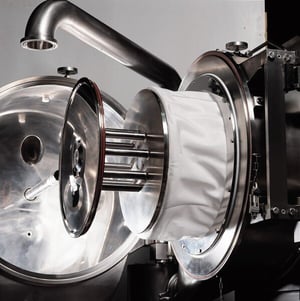
Inverting Filter Centrifuges are a unique design where the filter cloth is mechanically inverted to discharge solids. Instead of scraping or manual removal, the machine “turns the filter cloth inside out,” releasing the cake completely and discharging the solids through a chute on the front of the centrifuge. Material is evenly distributed due to an array of distribution bars that are central to the basket. These distribution bars also facilitate a highly efficient wash of the solids material. Because the Inverting Filter Centrifuge doesn’t leave a heel of material, thin cake filtration is possible for materials that are difficult to filter. In addition, an optional Pressure Added Centrifuge system (PAC) pressurizes the solids cake to significantly reduce residual moisture. These unique design features make the Inverting Filter Centrifuge the best option for poorly filtering materials and when high-purity and low residual moisture are key concerns.
Best Applications:
- Pharmaceutical and fine chemical processes requiring gentle product handling.
- High-value or toxic products where containment and operator safety are critical.
- Operations where product purity, washing efficiency, and low residual moisture are essential.
Key Advantages:
- Gentle cake discharge protects sensitive crystals and reduces product loss.
- Complete solids discharge without leaving a heel.
- Excellent washing efficiency for improved purity.
- Fully enclosed design enhances containment, protecting operators and the environment.
- The optional PAC system pressurizes the wet cake with heated pressurized gas to further reduce moisture.
Choosing the Right Centrifuge for Your Process
Selecting the best centrifuge comes down to your material properties, production goals, and regulatory requirements. For high-throughput chemical processing, horizontal or vertical peeler centrifuges may be ideal. For pharmaceutical or fine chemical manufacturing, where purity, low moisture levels, containment, and gentle handling are critical, inverting filter centrifuges are often the best fit.
Here’s a side by side comparison, summarizing the information we’ve just reviewed:
| Type | Working Principle | Best Applications | Key Advantages |
| Vertical Peeler Centrifuge | Vertical basket for solid-liquid separation |
|
|
|
Horizontal Peeler Centrifuge |
Horizontally-mounted basket or rotor |
|
|
| Inverting Filter Centrifuge | Filter cloth inverts mechanically to discharge solids gently |
|
|
At De Dietrich, we offer a full portfolio of centrifuge technologies—including vertical, horizontal, and inverting filter designs—engineered to meet the unique needs of the chemical and pharmaceutical industries. Backed by pilot testing, global service, and over 340 years of process expertise, we help customers achieve safe, reliable, and efficient separation.
Final Thoughts
Industrial centrifuges are essential to modern solid-liquid separation, but the right design depends on your process. By understanding the strengths of Vertical Peelers, Horizontal Peelers, and Inverting Filter Centrifuges, you can make an informed decision that balances efficiency, product quality, and lifecycle costs.
Contact us today to learn more about which centrifuge technology is best suited to your application.