
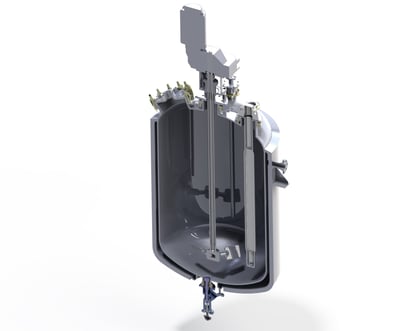
 Selecting the right agitator seal for a high-pressure glass-lined reactor is critical to ensuring process reliability, product quality, and safe operation. With multiple sealing technologies available, understanding the strengths and limitations of each option is essential.
In this three-part series, we’ll break down the most common sealing solutions used in these applications:
- Part 1: Dry-running (gas-lubricated) double mechanical seals
- Part 2: Lubricated (liquid barrier) double mechanical seals
- Part 3: High-purity sealing solutions for contamination-sensitive processes
We begin with dry-running seals, which are widely used in applications where cleanliness and contamination prevention are key priorities.
Understanding Dry-Running (Gas-Lubricated) Double Mechanical Seals
When specifying agitator seals for glass-lined reactors, dry-running double mechanical seals are often selected for applications where clean operation and contamination prevention are top priorities.
Unlike traditional sealing systems, dry-running seals use a gas—typically nitrogen—as the barrier medium between seal faces.
How Dry-Running Seals Work
Dry-running seals operate using a controlled gas barrier that:
- Maintains separation between seal faces
- Prevents process fluid from escaping to atmosphere
- Eliminates the need for liquid barrier systems
This creates a clean, controlled sealing environment that is especially beneficial in sensitive processes.
Key Advantages
1. No Risk of Barrier Fluid Contamination
Because these systems do not rely on liquid barrier fluids, there is no risk of fluid ingress into the process. This makes them ideal for applications where product purity is critical.
2. Clean and Low-Maintenance Operation
Dry-running seals eliminate the need for:
- Barrier fluid reservoirs
- Circulation systems
- Fluid disposal
This simplifies operation and reduces maintenance requirements.
3. Reduced Friction and Wear
With minimal or no direct contact between seal faces, wear is reduced—leading to longer seal life under the right operating conditions.
Typical Applications
Dry-running seals are commonly used in:
- Pharmaceutical intermediate production
- Fine chemical processing
- Vapor-phase or vacuum operations
- Pressures under 150 psig
While dry-running seals offer clear advantages, they are not suitable for every application. They require:
-
- A stable and reliable gas supply system
- Careful control of operating conditions
- Clean service environments with minimal solids or condensables
Final Thoughts
Dry-running double mechanical seals are an excellent choice when cleanliness, simplicity, and contamination prevention are the primary drivers. However, proper application is key to ensuring long-term reliability and performance.
In Part 2 of this series, we’ll take a closer look at lubricated (wet) double mechanical seals—the go-to solution for more demanding, high-load, and solids-containing applications.